Inclusive Education
Introduction:
T-TEL collaborates with the Ministry of Education’ agencies including NACCA and GES to ensure that all curriculum reform efforts are inclusive. This involves actively working to dismantle barriers that hinder inclusive education
At T-TEL, we are committed to supporting the government of Ghana and Ministry of Education in transforming Ghana’s education system to be inclusive, equitable, and accessible to all learners, including persons with disabilities. Guided by the principle “Nothing About Us Without Us,” our work in inclusive education is led and shaped by persons with disabilities and in partnership with government agencies and Organizations of Persons with Disabilities (OPDs). We believe that inclusive education is not just about access, but about participation, empowerment, and dignity.
Structure:
T‑TEL has supported Inclusive education by working with partners on:
1. Ghanaian Sign Language Curriculum Development
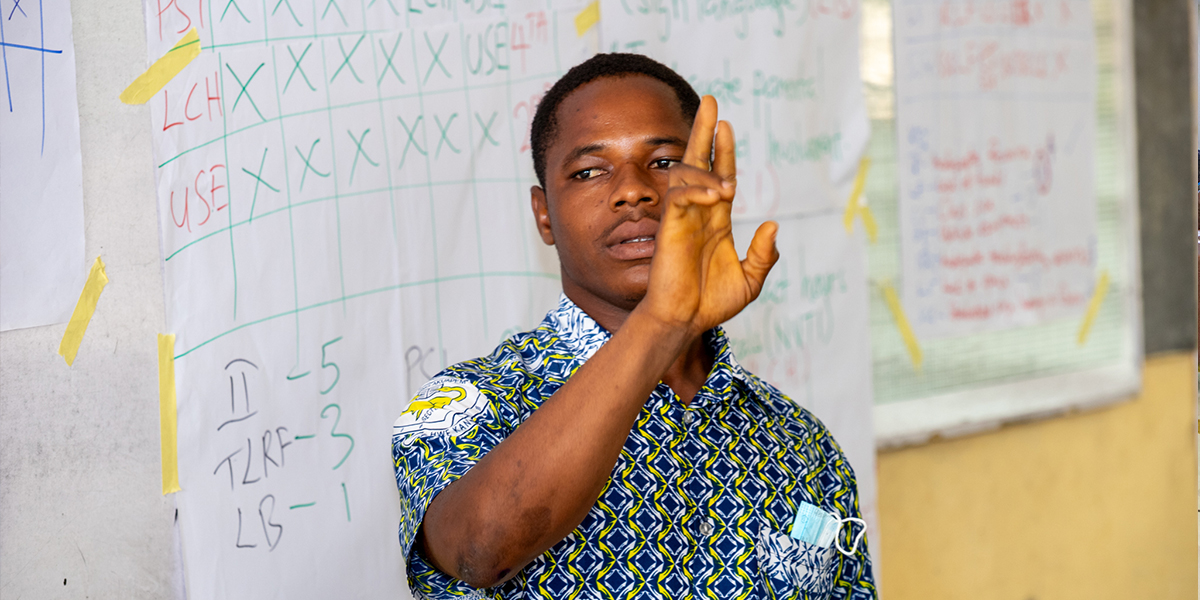
Deaf learners in Ghana primarily communicate using Ghanaian Sign Language, which, like spoken languages, has its own structure and regional variation. The lack of standardisation, formal recognition and consistent teaching of Ghanaian Sign Language has long created barriers to quality education for deaf students, leaving them facing inconsistent instruction, limited resources and exclusion from mainstream reform. T-TEL supported NaCCA and the Ghana National Association of the Deaf to write the first ever Ghanaian Sign Language Curriculum, spanning Kindergarten to Senior High School. It is being piloted in four schools, Savelugu School for the Deaf, Mampong Demonstration School for the Deaf, Sekondi School for the Deaf and Mampong Senior High Technical School for the Deaf and is designed to standardise the language, preserve deaf culture and secure its recognition as a full Ghanaian language, one that any school will eventually be able to offer as a language option.
2. Support for Learners with Visual Impairments to Learn Mathematics
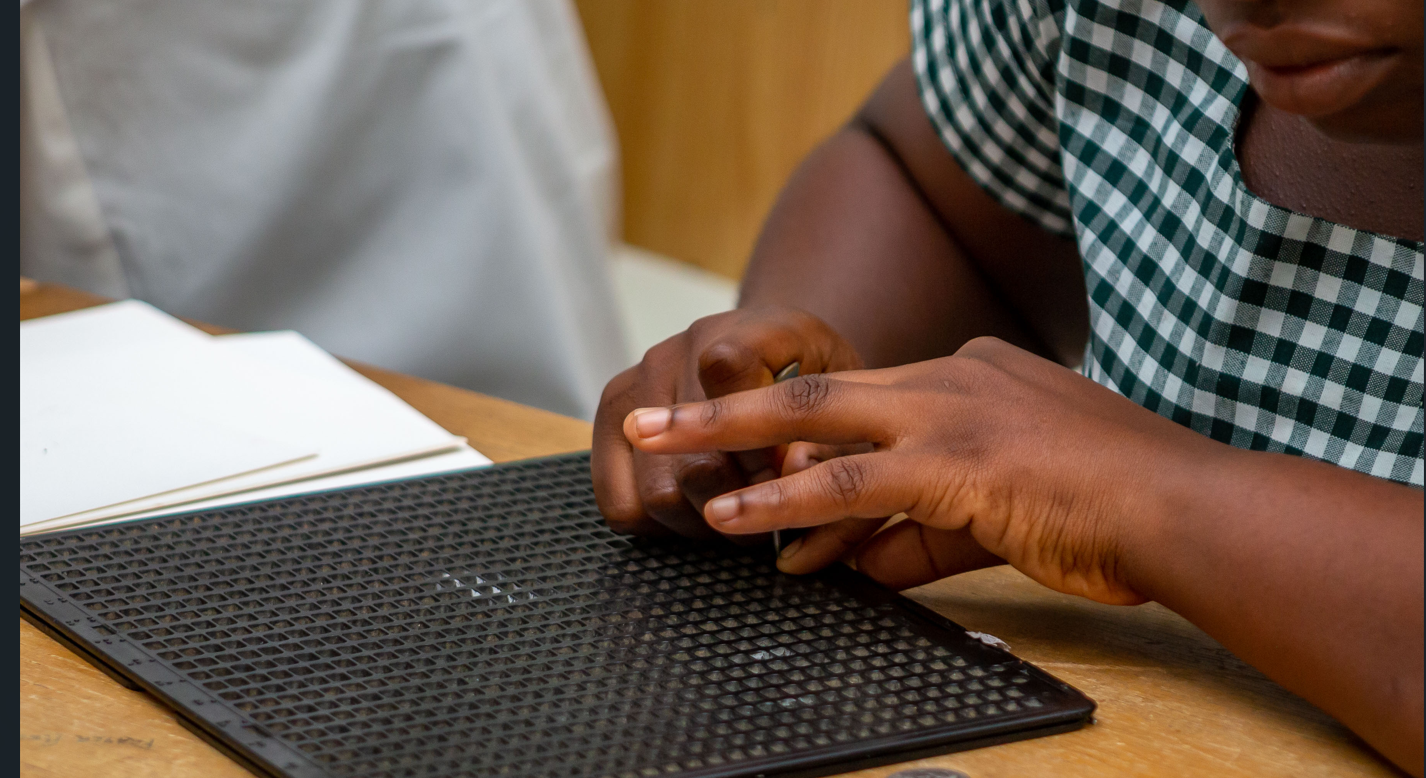
Mathematics relies heavily on visual elements such as graphs, diagrams, symbols and spatial reasoning, which has often excluded SHS learners with visual impairments from full participation. T-TEL supported NaCCA to develop a Mathematics curriculum for blind learners, trained teachers in accessible strategies, and supported learners with tactile 3D objects, computers, assistive technology and adapted instructional materials. This curriculum is being piloted at Okuapemann school and further expanded to six inclusive schools.
3. Assistive Technology and ICT Access
Access to quality education for learners and teachers with disabilities depends heavily on the availability of appropriate assistive technology, tools that break down barriers to learning by enabling people to access information, participate in classroom activities and express their knowledge independently. T-TEL works with GES through its Special Education Division (SpED) and the Ghana Blind Union to train and equip teachers with visual impairment with assistive technology and ICT tools. So far, 123 teachers have been trained, enabling them to deliver lessons confidently using digital resources.
4. Accessible Teaching and Learning Resources
T-TEL provided support to GES and NaCCA to ensures that teaching and learning materials produced through curriculum reform process, including teacher manuals, PLC handbooks and learner materials are available in accessible formats such as Braille, large print, screen reader friendly digital versions.
5. Teacher Training and Universal Design for Learning
Inclusive education requires teaching that recognises and accommodates the different ways learners engage with content, process information, and express their understanding. Many teachers, however, lack the training and tools to effectively support learners with disabilities in classrooms.
To address this, T‑TEL supported GES in promoting the use of Universal Design for Learning (UDL), a globally recognised framework that equips teachers to plan lessons accessible to all learners from the outset. UDL is built on the understanding that every learner’s style is unique and that flexibility in teaching is essential.
The UDL approach is grounded in three core guidelines:
● Multiple Means of Representation: presenting information in various formats to support how learners perceive and understand content (visual, auditory, tactile).
● Multiple Means of Action and Expression: allowing learners to demonstrate what they know in different ways (speaking, writing, drawing, using technology).
● Multiple Means of Engagement: offering different ways to motivate and involve learners based on their interests and needs.
Through training and integration into teacher education, T‑TEL contributes to national efforts to move away from one‑size‑fits‑all teaching towards classrooms where every learner, whatever their learning style, can succeed
6. Reviewing Curriculum Materials
T‑TEL supports GES and NaCCA in ensuring the review of Teaching and Learning Resources to ensure that language is inclusive, visual content is accessible, and activities accommodate the diverse needs of learners in every classroom